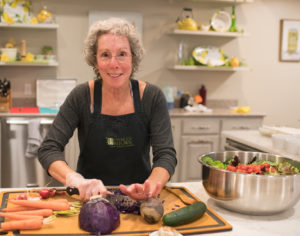

.jpg)
Veggie Soup: A leftover lovers litany
Vegetable Soup: A leftovers lover litany
Simple, hearty, and delicious
Prep time: 20 minutes
Onions, celery and carrots are at the base of nearly every soup I make. As a vegetarian, I make my soups using the juice of the olive oil and butter sauté of those three essential soup ingredients. It takes a few minutes more to chop then cook them up, but I have become so used to this ritual, that for me, it’s not a big deal. The good news is that there is healthful and delicious veggie or meat broths available (Imagine or Pacific Natural come to mind), and by all means, use those without a second thought.
The ingredients are pretty much whatever leftover cooked veggies you have on hand and the last of the raw cauliflower, broccoli, potatoes, corn, whatever! Even the veggies that you might not be so inclined to eat raw as they appear a day too old – yes, toss them in! You can also add in leftover pasta, beans, meat, anything that strikes you!
Ingredients:
Diced potatoes
Any and all leftovers
Directions:
- Start with either the broth or do the sauté with olive oil and butter combined. If you had time for the sauté, add in chopped fresh garlic near the end.
- Put this or the broth into a large pot.
- Add some water until it looks like you have a soup pot full. Bring to a boil.
- Add the potatoes and let them boil up, but don’t let them get too soft.
Here’s where it gets interesting…
- Depending on the leftovers, if they are raw, put them in now. If they are cooked already, wait until later.
- Consider adding canned beans, corn, tomatoes, or whatever else is handy.
- Season with pepper, a pinch of salt, and possibly some cumin.
- If you are adding leftover grains such as rice, pasta, or barley do it now at the same time as you add in the leftover veggies.
TaDa! You’ve got a fabulous dinner in no time flat and you used up the rest of what was in your fridge just in time for your weekly trip to the grocery store.
One last note:
I almost always make cheese bread to compliment the soup. This is another great use of leftovers…if a baguette has been around for an extra day, use it! Fresh bread works as well, of course. Slice up a good quality cheddar or swiss, layer it thinly on the sliced bread, and put it on a cookie tray under the broiler for just a couple of minutes. You will have yummy cheese bread that everyone will enjoy!
Positive Affirmation
Affirmations are spoken imagery from a positive point of view. The best use of affirmation occurs when we become aware of our ongoing internal dialogue or self-talk. We have decades of practice with the tendency to engage in judgmental and negative self-talk! The practice of positive affirmation will shift this internal dialogue into a pleasant, supportive means of nurturing yourself while becoming more familiar with optimism and compassion.
- Positive affirmation, also known as Cognitive Restructuring,effectively counters the harmful cycle of negative self-talk because of selective awareness—we are really only able to hold one statement at a time in our mind. Cognitive Restructuring is an acquired skill that requires practice! The primary purpose of affirmations is not to change objective reality, but to change subjective reality. As you strive to change your mind, feelings and behavior, you can design affirmations to offset the negative self-talk statements. Positive affirmations are even more powerful when used together during the relaxation response practice.
- Choose a Goal for your affirmations.
Choose something that you deeply desire, a state of being or a behavior that you wish to enjoy on a regular basis, involving your mind, body or emotions. Replace a negative behavior that you want to be rid of with a positive behavior. An example of a positive affirmation to support behavior change for a sedentary lifestyle would be to say, “I enjoy feeling energetic”. “I feel engaged in my physical health when I take a walk”. “I like feeling more relaxed after I walk”.
- Keep your affirmations completely positive.
Avoid the use of words such as no and not, and contractions such as don’t, shouldn’t, and wasn’t. Instead of “I will not feel anxious about this test”, consider, “I am fully prepared for the examination. I feel calm, relaxed, and confident in my ability to perform. The answers to all the test questions are available in my mind and I can produce them at a moment’s notice.”
- Make your affirmations personal.
More personal expressions motivate the deeper mind. Instead of “I will have an effective talk with my boss” or “My boss is going to understand my point of view” consider, “I am prepared for this meeting. I have the ability to communicate my point of view so that my boss will understand.”
- Use powerful affirmation words and vivid, enriching adjectives.
Consider, “I feel a deep, rich, soothing feeling of peace” as opposed to “I feel relaxed”; or “My mind is crystal-clear and alert, and the answers I need are available for instant recall” as opposed to “I know the answers”.
- State your affirmations in the present tense.
We may be waiting for the “someday” when we are going to start a business or lose weight. We all possess the potential to procrastinate and intend to do something “one of these days”. Consider, “This morning I will take 3 minutes to listen to the birds sing before I leave for work” as opposed to “I am going to start taking quiet time before work”; or “I forgive myself completely and thoroughly” as opposed to “Now I know how to do it better next time”.
- Keep your statements simple.
Use a subject (generally the subject of the sentence is you), a powerful verb, an object, and some adjective or adverbs to enrich your affirmation giving it a visual or otherwise sensual aspect.
- Detached observation.
Take time to pay attention to the self-talk patterns you have become used to. If you run out of the house in the morning to go to work, realizing that you left your lunch on the kitchen counter, instead of saying to yourself “You dufus! You forgot your lunch”, consider “Hmmm, how interesting. I was moving quickly this morning and in a hurry, so I left my lunch on the counter. I can slow down just a moment and breathe, then go back into the house to grab my lunch”.
As you begin to enjoy a heightened awareness of the words you choose in your self-talk, you will be creating new language patterns that will be kind, compassionate, and accepting of yourself. This then will be subtly transferred to the words you use when communicating with others.
A quick and delish dinner
Simple Tortilla Casserole
Prep time: 10 minutes; Baking time: 30 minutes
Purchased ingredients: Prepped ingredients:
Whole grain tortillas Grated cheddar and jack cheese
Salsa or chili sauce Chopped cilantro
Black olives, drained Chopped green and purple cabbage
Grilled peppers, canned or jar, drained
Black or pinto beans, drained
- Pour a bunch of salsa or chili verde sauce into the bottom of a 9 x 13 glass casserole dish.
- Place 3 tortillas on top of the salsa or sauce.
- Cover with ½ of the cheese.
- Beans next.
- Then peppers.
- Sprinkle on the cilantro and olives.
- Layer with more torts.
- Top it off with a healthy dousing of salsa or chili sauce.
- Cover with foil and bake at 350 for 28 minutes.
- Remove foil, sprinkle on remaining cheese and bake 2 more minutes.
- Top with a lot of cabbage at the table for added zip and crunch.
This dinner is so quick, so yummy, and so simple, that you won’t even mind that it is a complete protein, high fiber, and low fat meal!
My choice is to shop at our local co-op for all canned or prepared items; I buy organic and I recommend you consider this as well—there will be no added fats, coloring, sweeteners, preservatives, etc. Having said that, the point here is to have a quick and delish dinner, you should buy whatever you think is best.
You already know that I am not a recipe user. I love free flow creativity in the kitchen. This dish can have virtually anything you want to put in it that you and your family like and that maintains the Mexican or Spanish flavor. And of course, you can leave out any of the ingredients that don’t thrill you.
Finally, I sometimes buy a bunch of rice to go with this dinner. There’s a fab little Mexican place in town, called Tortilla Grill, which uses all organic ingredients for their rice and beans. It makes me feel better to bring that kind of rice home for an easy side dish to an already simple dinner. The big box food stores sell cooked Mexican or Spanish style rice also, again your choice. Occasionally, if I am feeling really sassy, I will throw the rice into the casserole, on top of the beans to bake into the cheesy goodness!
Enjoy this meal—it is one that kids and spouses like—if you have them around the house—and either way, you’ll love it because of the ease and taste!
 Posted in Recipes, Updates |
  Tags: delicious, easy, healthy, newsletter, quick, recipe, Tortilla Grill |
  4 Comments »
Sally Edwards: HeartZone Training seminar
 On February 27 and 28, Sally will be in Grass Valley to share her expertise, enthusiasm, and innovative training methods. She is the “inventor” of modern heart rate zone training, as well as a successful and motivating business woman.
Check out the information on her site to learn more about the seminar. I can’t wait to see her speak locally, will you join me? http://tinyurl.com/yex79rx
Passion Into Action Conference
 Join us for a day of learning, growing, sharing, laughing, and loving. See you on January 23!
Moss
 I dig moss. Not with a trowel, but with my heart. What a tenacious plant! Moss practically dies off in the summer heat, becoming a dried up, brown-gray, dormant plant, but once the rains start again in the fall, ahhh, moss comes into it’s own. It’s a miracle to behold; as the plant fills with water, it plumps up, turns an exquisite green, then dazzles the universe with indefatigable beauty.
In my reverence for nature and living entities, moss has always earned a high level of respect from me. Taking daily walks in the woods, I keep track of the status of the numerous varieties that grow on the tree trunks and rocks near my house. The abundant precipitation of the fall and winter brings out the luscious texture, iridescent color, and moist plumpness of this odd and amazing plant.
Do you know what I mean?
Pals
I have a friend who is also a Facebook buddy, with whom I now share a new element in our friendship. Every Tuesday, Thursday, and Saturday, before 9 PM, we engage in a common activity, then send an e-message to each other about our accomplishment. That activity is push-ups, and we have become Push-Up Pals!
The agreement is to do 3 sets of 10 push-ups, in proper form, and not the bent knee kind, either. The real thing. After our first day of participation in the push-up pal program, I suggested that we add in crunches. After all, we would be waiting a few minutes in between sets of 10, so why not throw in crunches? 3 sets of 50 crunches, 5 different leg positions to work the range of abdominals. That’s 150 crunches, 30 push-ups, and a great little workout!